HOCl.love
How to make inexpensive disinfectant and use it safely
What is HOCl?
Your body's own disinfectant
Hypochlorous acid (HOCl) is the disinfectant your own white blood cells make to fight infection. You can make it at home, cheaply, to keep surfaces clean.
- Your body’s own disinfectant. The same molecule your immune system uses against germs.
- Works at lower strength than bleach. Against tough C. difficile spores, it needs about half the strength (PDF, opens in a new tab) a bleach product does.
- Inexpensive. About 25 to 30 cents a litre from tablets.
- Comes with a label. The tablets carry an EPA label (PDF, opens in a new tab) for surfaces, food-contact sanitizing and emergency drinking water.
Make it from tablets, with a generator, or with a small USB kit: see three ways to make it. Home-made solution is for cleaning surfaces. For eyes, skin and wounds, people use commercial products made for them; Uses shows what the studies found.
The chemistry, for the curious
The tablets are NaDCC (sodium dichloroisocyanurate). Dissolved, they give a solution at about pH 6 to 7, where 80 to 90 percent of the free chlorine is HOCl, the faster-acting form. Household bleach in water sits at pH 11 to 12, so most of its chlorine is the slower hypochlorite. Against C. difficile spores, the tablet label needs 4306 ppm for 4 minutes, where a bleach product needs 9000 ppm for 5 minutes. In clean laboratory tests (opens in a new tab), tablet solution and bleach at the same strength kill about equally; under blood or other body fluids (opens in a new tab), tablet solution keeps working at roughly a quarter of the strength bleach needs.
Tablet solution also carries cyanurate, whose safety reviews (opens in a new tab) cover drinking water (PDF, opens in a new tab) only, and none of the studies of HOCl on eyes, mouths, skin or wounds used NaDCC.
Scientific American also has an article on whether HOCl works (opens in a new tab) and a podcast on HOCl as a natural disinfectant (opens in a new tab).
For mutual aid
HOCl is one of the cheapest hygiene tools a community group can hand out. A US$30 box of 100 small tablets makes about 100 litres of sanitizer for food-contact surfaces: enough for a community kitchen, a shared fridge or a disaster kit. The calculator works out tablets and cost for each job.
Uses and strengths
What for, how strong, and what not to do
Strength is measured in ppm, parts per million: 1 ppm is 1 milligram of chlorine in a litre of water. Strengths for surfaces come from the tablet label, and strengths for drinking water from the safe limits for drinking water. Each card links to its sources.
Make with tablets
Drinking water1 to 2 ppmClear water. Filter or settle cloudy water first.
- How to make
- A drinking-water tablet sized to your container, at the dose on the packet. The Aquatabs chart, written for 5 ppm, gives 8.5 mg per 1 L and 167 mg per 20 L. Not the 334 mg surface tablet: one is for about 20 to 50 L.
- Strength
- About 1 to 2 ppm. Never above 5 ppm.
- Leave it on
- 30 minutes
- Evidence
- The usual dose is about 1 ppm, no more than double that to start, and never above 5 ppm (WHO and JECFA limits). Across many trials of home water chlorination, ones where people knew they were treating their water found about a quarter less diarrhoea; blinded NaDCC trials in Ghana and India, where nobody knew which water was treated, found no difference. Where tablet and container sizes did not match, 11.7% of samples went over 5 ppm. Chlorine does not kill Cryptosporidium: WHO testing of Aquatabs found a 0.2 log cut. At the packet dose, the chlorine left in treated water after 30 minutes is many times what kills cholera bacteria in the lab, and a trial that paired tablets with handwashing found fewer cholera infections in treated households.
- Sources
- WHO NaDCC fact sheet (PDF, opens in a new tab)
- WHO food-additive safety review (opens in a new tab)
- WHO emergency water guidance (PDF, opens in a new tab)
- WHO Aquatabs report (PDF, opens in a new tab)
- 2010 Ghana water trial (opens in a new tab)
- 2013 India water trial (opens in a new tab)
- 2007 Bangladesh water trial (opens in a new tab)
- 2010 Tanzania by-products study (opens in a new tab)
- 2006 NaDCC tablet review (opens in a new tab)
- Aquatabs dosing chart (opens in a new tab)
- 2015 water treatment review (opens in a new tab)
- 2016 Dhaka cholera trial (opens in a new tab)
- 2016 hospital cholera trial (opens in a new tab)
Food-contact surfaces, no rinse100 ppmCounters, cutting boards, dishes, community fridges. Clean them first.
- How to make
- 1 PurTabs 334 mg tablet per 32 oz (about 0.95 L) of water: 100 ppm on the label chart. One tablet in 1 L makes about 104 ppm.
- Strength
- 100 ppm maximum
- Leave it on
- 1 minute, then drain and air dry
- Evidence
- US rules cap no-rinse NaDCC solution on food-contact surfaces at 100 ppm. The EPA label claims S. aureus and Salmonella at 100 ppm in 1 minute on cleaned surfaces.
Disinfecting surfaces1076 ppmBathrooms, door handles, other high-touch surfaces. Rinse any food-contact surface afterwards.
- How to make
- 1 PurTabs 3.3 g tablet per 32 oz (about 0.95 L) of water: 1076 ppm on the label chart. Clean off dirt first.
- Strength
- 1076 ppm on the label; 1000 ppm in health-care guidance
- Leave it on
- 10 minutes on the label; at least 1 minute in health-care guidance
- Evidence
- The label claims MRSA, E. coli O157:H7, rhinovirus, HIV-1 and hepatitis A and B at 1076 ppm in 10 minutes, and SARS-CoV-2 in 4 minutes. Health-care guidance uses 1000 ppm on surfaces after cleaning, and Médecins Sans Frontières makes it from NaDCC tablets. Hypochlorous acid of at least 150 ppm is on the WHO essential medicines list as a surface disinfectant.
Shower floors (athlete's foot)1076 ppmShower floors, bath mats and other hard surfaces. Not skin.
- How to make
- 1 PurTabs 3.3 g tablet per 32 oz (about 0.95 L) of water: 1076 ppm on the label chart. As for disinfecting surfaces.
- Strength
- 1076 ppm
- Leave it on
- 10 minutes
- Evidence
- The label claims Trichophyton interdigitale, the athlete's foot fungus, at 1076 ppm in 10 minutes on hard surfaces.
Vomit, diarrhoea and spills2153 ppmNorovirus clean-up, blood and other body fluids. Wipe up the mess first.
- How to make
- 2 PurTabs 3.3 g tablets per 32 oz (about 0.95 L) of water: 2153 ppm on the label chart. Clean off the soil first.
- Strength
- 2153 ppm on the label for norovirus; 1000 to 5000 ppm in CDC advice; 5000 ppm for blood or body-fluid spills over about 10 ml
- Leave it on
- 1 minute at 2153 ppm (label). CDC: at least 5 minutes.
- Evidence
- The label claims norovirus at 2153 ppm in 1 minute. CDC advises 1000 to 5000 ppm for at least 5 minutes against norovirus. Health-care guidance uses 5000 ppm for large blood spills.
C. difficile spores2153 ppmSurfaces near someone with C. diff.
- How to make
- 2 PurTabs 3.3 g tablets per 32 oz (about 0.95 L) of water: 2153 ppm on the label chart. Four tablets per 32 oz for 4306 ppm.
- Strength
- 2153 ppm, or 4306 ppm
- Leave it on
- 10 minutes at 2153 ppm, or 4 minutes at 4306 ppm
- Evidence
- Both are EPA label claims for hard surfaces.
Commercial products only
Eyes and eyelidsNo home recipeBlepharitis, eyelid hygiene.
- Home recipe
- Studied with commercial products. None used tablet solution. No home recipe.
- Used in studies
- 100 ppm (0.01%) in trials
- Evidence
- Small trials of 0.01% HOCl products in saline, pH-controlled and sterile, for blepharitis. In one, three authors worked for the maker. None used NaDCC.
Mouth rinseNo home recipeGum disease and plaque.
- Home recipe
- Studied with commercial products. None used tablet solution. No home recipe.
- Used in studies
- 100 to 500 ppm in trials
- Contact time in studies
- 5 minute gargle (100 ppm) or 30 second rinse (250 to 500 ppm)
- Evidence
- A 100 ppm commercial mouthwash cut salivary bacteria by 62% and 77% in a trial. In another, 250 and 500 ppm rinses cut them by 33%, against 58% for chlorhexidine, and counts were back to baseline within an hour. None used NaDCC.
Skin: acne and eczemaNo home recipeAcne, eczema, atopic dermatitis.
- Home recipe
- Studied with commercial products. None used tablet solution. No home recipe.
- Used in studies
- No set strength
- Evidence
- Reviews of commercial products, one by paid consultants to the maker. Bleach baths for eczema, the nearest home version, used sodium hypochlorite, and meta-analyses disagree: one found them no better than water baths, a later one a probable 22% relative improvement in severity.
WoundsNo home recipeInfected wounds, under a clinician's care. Studied in hospital, with no home recipe.
- Home recipe
- Not a self-treatment recommendation. In Israel, clinicians put a licensed product, K-Sept 1000, on infected wounds as a wet dressing. Clean wounds get sterile saline. Keep it off the eyes. The tablets on this page have never been tried on a wound. The nearest match, one 3.3 g PurTabs or Klorsept tablet in 1 litre, about 1026 ppm, is the same strength but registered for surfaces only, and less acidic.
- Used in studies
- 1000 ppm in the licensed clinical product (K-Sept 1000, Israel): one tablet in 1 litre of water, buffered at pH 5 to 6.
- Contact time in studies
- Sterile gauze soaked in the solution, put on three times a day for 8 days in the one study
- Evidence
What the study found. One hospital study, 35 infected wounds in 30 patients, 8 days of dressings: no adverse events, less pain, swelling and bacteria, and 33 of the 35 wounds healed.
Its limits. One centre, one assessor and no comparison group, so routine care may explain the gains. Israel withdrew the licence in 2006 for lack of safety evidence and restored it in 2020. Wound fluid uses up weaker solutions fast.
What others say. WHO found the trials too small to list HOCl for wounds (2021, 2025), though it looked effective and acceptably safe. US wound products use 100 to 200 ppm.
- Sources
- 2022 fresh wound trial (opens in a new tab)
- 2007 wound care papers (opens in a new tab)
- 2014 wound care review (opens in a new tab)
- 2015 expert wound advice (opens in a new tab)
- WHO medicines committee, 2021 (PDF, opens in a new tab)
- WHO expert review, 2025 (PDF, opens in a new tab)
- 2001 lab study on tissue (opens in a new tab)
- 2023 Israeli wound study (opens in a new tab)
- Israeli wound study record (opens in a new tab)
- K-Sept 1000 product page (opens in a new tab)
- MSF NaDCC drug sheet (PDF, opens in a new tab)
- 1985 hospital disinfectant study (opens in a new tab)
- 1988 blood serum study (opens in a new tab)
- WHO essential medicines listing (opens in a new tab)
- PurTabs label (PDF, opens in a new tab)
- Klorsept label (PDF, opens in a new tab)
Feet: athlete's foot and nail fungusNo home recipeOn skin or nails.
- Home recipe
- Studied with commercial products. None used tablet solution. No home recipe.
- Used in studies
- 64 to 128 ppm in one lab study
- Evidence
- Lab studies only: a commercial HOCl stopped nail fungi growing at 64 to 128 ppm. No clinical trial of HOCl for athlete's foot or nail fungus was found. The fungus study the old page linked here tested eye infections.
Fogging a roomNo home recipeA fog or mist from equipment made for it, with nobody in the room.
- Home recipe
- No home recipe. Fogging needs a product labelled for it and a fogger made for it, and the tablet label gives no fogging directions. Keep people out of the room while it runs.
- Used in studies
- 250 to 8,700 ppm fogged
- Contact time in studies
- 16 minutes to hours, in empty rooms or chambers
- Evidence
- In a sealed chamber, a 250 ppm fog inactivated influenza A; SARS-CoV-2 needed 8,700 ppm. A commercial fog at about 550 ppm cut bacteria on surfaces 6.59 log, and home-made versions did much worse. Two animal studies of breathing 250 ppm fog, both funded by makers, found no harm in rats over 3 months and minimal, likely reversible lung changes in mice over 10 days. In the lab, fog from 500 ppm damaged human skin cells, and NaDCC mist irritated rats' airways. Air sampled while workers sprayed PurTabs solution stayed under workplace chlorine limits, and a small hospital pilot at trace levels found no symptoms. No study compares spraying with wiping in people, and WHO advises against fogging chlorine disinfectants indoors.
- Sources
- WHO surface guidance (PDF, opens in a new tab)
- June 2018 PurTabs data sheet (PDF, opens in a new tab)
- 2022 dry-fog virus study (opens in a new tab)
- 2022 fog on surfaces study (opens in a new tab)
- 2021 NaDCC mist rat study (opens in a new tab)
- 2020 fog mouse study (PDF, opens in a new tab)
- 2026 fog rat study (opens in a new tab)
- 2024 fog on cells study (opens in a new tab)
- EPA fogging guidance (opens in a new tab)
- CDC sprayer precautions (opens in a new tab)
- 2026 hospital fog pilot (opens in a new tab)
- 2025 spraying review (opens in a new tab)
Emergencies only
Hand washing in outbreaksNo home recipeEbola responses, until soap and water or alcohol rub arrive.
- Home recipe
- No home recipe. The tablet label has no use on skin. Chlorine hand washing is an emergency measure, used until soap and water or alcohol rub are available, and not for people with skin conditions such as contact dermatitis.
- Used in outbreaks
- 0.05% (500 ppm) chlorine in Ebola responses
- Contact time
- 40 to 60 seconds, until hands are dry
- Evidence
- Ebola responses have used 0.05% (500 ppm) chlorine for hand washing. In a trial on hands carrying test organisms, one wash with 500 ppm NaDCC removed or killed them about as well as soap or hand sanitizer. In a 4-week trial of hand washing ten times a day, every method raised skin irritation scores, NaDCC and generated hypochlorite the most, and 4 of 91 people developed dermatitis; the authors judged all the changes minor. Ebola guidance moves people to soap and water or alcohol rub as soon as they arrive, and allows chlorine until then on very low-certainty evidence. A systematic review found very limited, very low-quality evidence on how chlorine compares.
Don't
The sources advise against these.
Medical instrumentsChlorine solution is not a sterilant
- Covers
- Sterilizing tools.
- Why
- The label allows 2153 ppm only to pre-clean instruments before sterilization or high-level disinfection.
Fruit and vegetablesNot with NaDCC
- Covers
- Washing produce.
- Why
- US rules for washing produce name sodium hypochlorite, and NaDCC is not on the list. The tablet label has no produce use.
Misting home-made solutionWipe it on
- Covers
- Into the air you breathe, or onto people.
- Instead
- Wipe it on with a cloth. If you use a spray bottle, spray the cloth.
- Why
- The label says "Do not breathe spray mist." Fogging chlorine indoors harms workers' airways, and EPA does not recommend fogging a disinfectant whose label gives no fogging directions. Home-made solution has none.
Three ways to make it
Tablets, a generator, or a USB kit
Tablets are the simplest way, and the only one here with a label to follow. Generators make HOCl from salt water by electrolysis.
Whichever you choose, home-made solution is for cleaning surfaces. Open an option for what to buy and the steps. The safety rules for generators follow the options.
 Option 1
NaDCC tablets
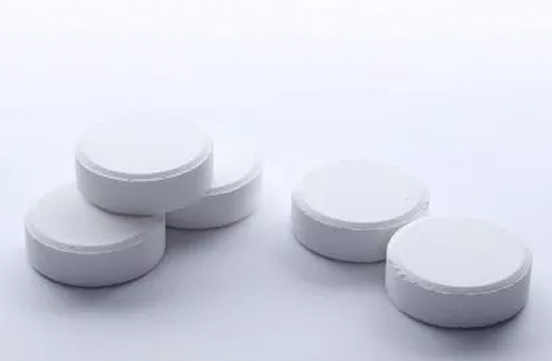
The simplest way. Drop a tablet in water, let it dissolve, and it is ready.PurTabs 334 mg, US$30 for 100 (27 September 2026)
Médecins Sans Frontières uses NaDCC tablets as its standard chlorine disinfectant (opens in a new tab). Dry, they keep 3 to 5 years (opens in a new tab). Made up, the solution does not: make it fresh.
Which tablets
We use PurTabs because their label (PDF, opens in a new tab) covers hard surfaces, food-contact sanitizing and emergency drinking water, with a dilution chart for a 32 oz bottle, about 0.95 litres. Other NaDCC tablets work too: Tablets compared lists them.
- PurTabs 334 mg for food-contact surfaces: one per 32 oz makes 100 ppm. 100 tablets for US$30 at Zogics (opens in a new tab) (price on 27 September 2026).
- PurTabs 3.3 g for disinfecting: one per 32 oz makes 1076 ppm, two make 2153 ppm. The 334 mg tablet stops at 538 ppm on the chart, six to a bottle. 200 tablets for US$49.95 at Zogics (opens in a new tab) (price on 27 September 2026).
How to make it
- Put on gloves and eye protection: the tablets are corrosive (see Safety).
- Fill a clean bottle with cool water, not hot.
- Drop in the tablets and let them dissolve fully. Use clean, dry utensils.
- Label the bottle with the strength and the date.
- Clean the surface first, then wipe the solution on with a cloth. Dirt uses up chlorine (2024 disinfectant study (opens in a new tab)).
- A fresh batch each day is best. It keeps up to 3 days in a closed container out of sunlight, at room temperature; test it with a strip if you keep it longer.
| Job | Tablets | Strength | Leave it |
|---|---|---|---|
| Food-contact surfaces, no rinse | 1 × PurTabs 334 mg | 100 ppm | 1 minute, then drain and air dry |
| Disinfecting surfaces | 1 × PurTabs 3.3 g | 1076 ppm | 10 minutes on the label; at least 1 minute in health-care guidance |
| Vomit, diarrhoea and spills | 2 × PurTabs 3.3 g | 2153 ppm | 1 minute at 2153 ppm (label). CDC: at least 5 minutes. |
| C. difficile spores | 2 × PurTabs 3.3 g | 2153 ppm | 10 minutes at 2153 ppm, or 4 minutes at 4306 ppm |
 Option 2
HOCl generator
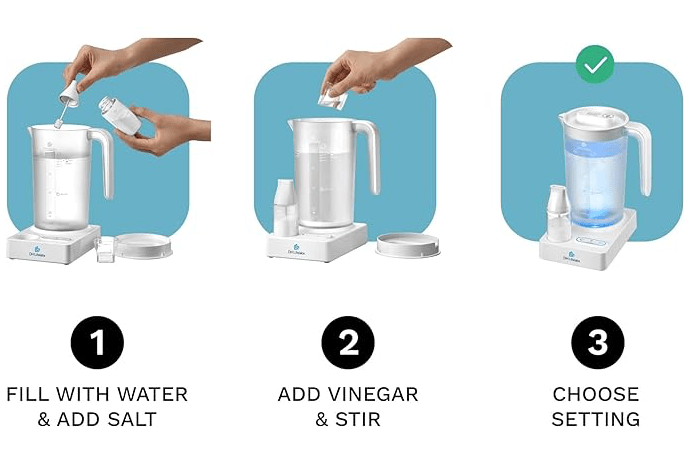
A machine that electrolyses water, salt and vinegar. Follow its instructions, then test the batch.Home versions about US$65 to US$220 (27 September 2026)
You can also make HOCl by electrolysing water, salt and vinegar (opens in a new tab). The simplest way to do that is an HOCl generator: follow its instructions for the strength you want. Home versions come in several sizes. On 27 September 2026, home generators sold online cost about US$65 to US$220.
Read the safety rules for generators, under the options, first. Test every batch with chlorine and pH strips. Electrolysis makes salt water alkaline: in a 2024 study of home electrolysis (opens in a new tab), salt water set to pH 5 with vinegar came out at about pH 8.3, where most of the chlorine is the slower hypochlorite, and the authors added vinegar afterwards to bring it to about pH 6. They note that some generator makers only say to add vinegar before. If your strip reads above pH 7, the solution is weaker, since more of its chlorine is the slower hypochlorite, but it still works on surfaces: use it as it is, and add no more vinegar.
Generator solution is for cleaning surfaces, like tablet solution. The strengths in Uses come from the tablet label, which does not cover it. In that 2024 study (opens in a new tab), home-made solution at about 250 ppm and pH 6 cut bacteria on surfaces about as well as diluted bleach or 70% alcohol; the authors advise making it stronger than that, because home production has little quality control.
Where to buy generators
Not a full list. Prices are the sellers’ on 27 September 2026.
- Eco One Portable (opens in a new tab), EWCO: 1 litre, up to 500 ppm. US$199.99.
- Hypo 7.5 (opens in a new tab), Hypo Source: 7.5 litres, 200, 500 or 1000 ppm. US$2,200.
- EWCO 300 flow system (opens in a new tab), EWCO: makes solution on site. US$4,999. The old page listed this link as the EWCO 240, up to 300 ppm. Maker’s page (opens in a new tab).
 Option 3
Portable USB generator
The experimental way. Build a small generator from parts.Parts about US$67 (27 September 2026)
For a more experimental approach, build a portable generator from parts. The parts cost about US$67 in all, at prices seen online on 27 September 2026, with the old page’s estimates for the vinegar, jar and spoon.
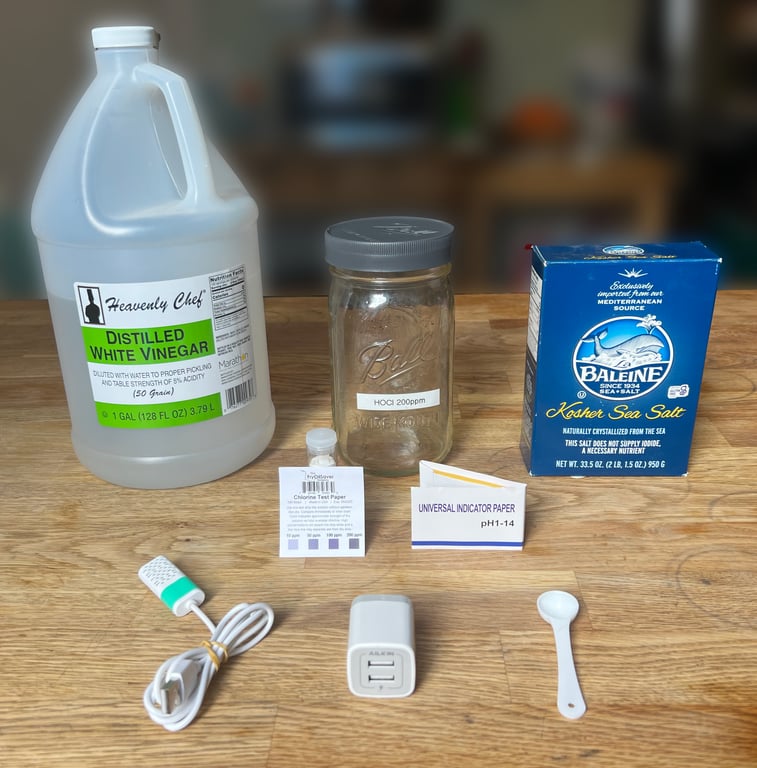
What you need
- Distilled white vinegar, any brand (about US$3, old page’s estimate)
- A 32 oz mason jar, or any 1 quart or 1000 ml glass or plastic container. Not metal (about US$4, old page’s estimate)
- Non-iodized salt, any brand (about US$10)
- Chlorine test strips, 0 to 200 ppm, such as Hydrion from Micro Essential Laboratory (opens in a new tab) (about US$20)
- pH test strips, such as Hydrion (opens in a new tab) (about US$6)
- PWPAM sodium hypochlorite generator (opens in a new tab) (US$11.99 on 27 September 2026; see the note below)
- A 2 A USB wall charger; a 1 A charger also works (about US$9 for a pack of three)
- A 1/2 tsp measuring spoon (about US$4, old page’s estimate)
Steps
These steps are for information only, and you follow them at your own risk. If you are not comfortable with basic chemistry, buy a ready-made generator (Option 2). Read the safety rules for generators, under the options, first.
- Fill the mason jar with tap water.
- Add 1 tsp of salt.
- Add 1/2 tsp of vinegar. No more: too much acid releases chlorine gas.
- Stir until the salt has fully dissolved.
- Plug the generator into the USB wall charger, and the charger into a power outlet. Work in a ventilated space, away from flames.
- Put the green tip of the generator in the jar. Small bubbles should come off it.
- Let it run for 15 minutes with a 2 A charger, or 30 minutes with a 1 A charger. The charger’s fine print gives its output.
- Test with the chlorine strips. The reading should be about 100 to 200 ppm. Run it longer for a stronger solution.
- Test with the pH strips. The reading should be around 6.
- Label the jar with the strength and the date. Use it on surfaces: see Uses.
About the PWPAM generator
Followed as its own instructions say, the PWPAM generator makes sodium hypochlorite (opens in a new tab), or chlorine bleach, which is closely related to HOCl (opens in a new tab). The small amount of vinegar in the steps lowers the pH, so more of the chlorine is HOCl, the faster-acting form. Use no more vinegar than the steps give: below pH 4 the solution releases chlorine gas, which can seriously irritate the airways (2024 home electrolysis study (opens in a new tab)).
For more about the generator, see its original manual (PDF, 5 MB).
Caution
Safety for generators (options 2 and 3)
- Electrolysis gives off hydrogen, which burns. Run a generator in a ventilated space, away from flames.
- Vinegar goes into the salt water only, in the amount the steps give. Never add acid to tablet solution or bleach. Below pH 4, chlorine solution releases chlorine gas (a 2024 home electrolysis study (opens in a new tab) and a CDC report on mixing bleach (opens in a new tab)).
- Test every batch with chlorine and pH strips. The pH should stay above 4, and the chlorine should match the strength you need.
- Generator solution is for surfaces too: not for drinking, eyes, mouth, skin or wounds.
- Use a glass or plastic container, never metal (2024 home electrolysis study (opens in a new tab)). Label it with the strength and the date, and keep it away from children.
Or buy it ready-made
Ready-made HOCl products
To try HOCl without making it, these sellers offer it bottled. Not a full list, and no listing is sponsored. Strengths and uses are as each maker states them.
- Briotech (USA): Topical Skin Spray (opens in a new tab), 140 ppm, sold for skin; Sanitizer + Disinfectant (opens in a new tab), 180 ppm, for surfaces; Pure Hypochlorous (opens in a new tab), 200 ppm, sold for skin, pets and cleaning.
- Pure&Clean (USA): Surface Cleanser (opens in a new tab), 200 ppm; Disinfectant-Sanitizer (opens in a new tab), 460 ppm. Both for household cleaning.
- Zogics (USA): Hypochlorous Acid Disinfectant (opens in a new tab), 250 ppm, for surfaces, healthcare and veterinary use.
- Sky Dental Supply (USA): All-Purpose HOCl Cleaner (opens in a new tab), 300 ppm, for surfaces.
- CleanSmart (USA): Hospital Disinfectant (opens in a new tab), 500 ppm, sold as hospital grade.
- Indco (USA): AquaCleanse (opens in a new tab), 500 ppm, for surfaces; now sold as a 5-gallon pail (US$109.99 on 27 September 2026).
Check the strength
Use free-chlorine test strips that read up to 1000 ppm, or high-range strips for 2000 ppm and above. Pool strips that stop at 10 ppm cannot read surface-strength solution. Strips are rough guides: one comparison of test methods (opens in a new tab) found errors of 5% to 48%. With NaDCC they read somewhat high, because cyanurate binds some of the chlorine (a 2019 chemistry model (opens in a new tab) and a 2018 chemistry review (opens in a new tab)). For generator solution, test the pH too: a 2024 study of home electrolysis (opens in a new tab) set it to about 6.
Ideas for distribution
How mutual aid groups hand out HOCl:
- Street outreach: tablets with printed instructions, gloves and a labelled bottle.
- Encampments: tablets plus printed instructions for mixing on site.
- Disaster response: stockpile tablets, drinking-water tablets included.
- Community fridges: wipe down with 100 ppm solution, no rinse (US food-contact rule (opens in a new tab)).
Calculator
How many tablets for your water
Pick the job, the tablet and how much water. The answer shows at the top.
It offers the three tablet sizes whose chlorine is on their label (31.10 percent), and drinking-water tablets sized by their dosing chart. Uses on the body are not presets: their studies used commercial products. The 334 mg and 3.3 g prices are Zogics’ on 27 September 2026; the others are rough figures from an earlier version of this page. Enter what you paid.
Safety
Eight rules to read before you start
Read these before you make your first batch. The tablets are corrosive until they dissolve, and the solution reacts with other cleaners.
Before you start
- Make it freshBest made each day. It keeps up to 3 days in a closed, dark bottle; test it with a strip if you keep it longer. Label the bottle with strength and date.
- Never mix itNot with acids, vinegar, ammonia, urine or other cleaners. The mix gives off chlorine gas (opens in a new tab) or chloramines (opens in a new tab).
- Home-made is for surfacesNot for eyes, mouth, skin or wounds. For drinking water, use drinking-water tablets at the packet dose.
All eight rules
- Wear gloves and eye protectionWear them when you dissolve tablets. The tablets are corrosive, can cause irreversible eye damage (PDF, opens in a new tab), and are harmful if swallowed, breathed in or absorbed through skin.
- Use cool, clean water. Make it freshDissolve tablets fully in cool, clean water before use. Make solution fresh: a new batch each day is best. Surface solution keeps up to 3 days in a closed, dark bottle at room temperature; if you keep it longer, test it with a strip first. Then label every bottle with its strength and the date.
- Never mix it with anythingNever mix tablets or solution with acids, vinegar, ammonia, urine or any other cleaner: the mix releases chlorine gas (opens in a new tab) or chloramines (opens in a new tab). Never mix the tablets with other chlorine products, such as calcium hypochlorite: that can cause fire or explosion (PDF, opens in a new tab).
- Wipe it on. Never mist itNever spray or fog solution onto people or into the air you breathe. The tablet label says not to breathe spray mist (PDF, opens in a new tab), and chlorine fog indoors harms workers' airways (PDF, opens in a new tab). Wipe it on with a cloth; if you use a spray bottle, spray the cloth. Fogging a room takes a product whose label gives fogging directions and a fogger made for it, with nobody else in the room (opens in a new tab).
- Do not drink cleaning solutionDo not drink cleaning-strength solution. Only water treated with drinking-water tablets, at the dose on the packet, is for drinking.
- Keep it away from childrenKeep tablets and solution away from children. In the US, Poison Control (PDF, opens in a new tab) is 1-800-222-1222.
- Splashed in an eye? RinseIf solution or tablet dust gets in an eye, rinse it with water for 15 to 20 minutes and call Poison Control.
- Store tablets cool and dryStore tablets cool and dry, below 40 °C, sealed from moisture.
Tablets compared
Sizes, what each one makes, and prices
Match the tablet to the job: small ones sized per litre for drinking water, bigger ones for surfaces.
- PurTabs: for hard surfaces, food contact and emergency drinking water. The 334 mg tablet suits food-contact strength; the 3.3 g tablet suits disinfecting.
- Aquatabs and UNICEF tablets: drinking-water tablets, each sized for a volume of water, as the Aquatabs dosing chart (opens in a new tab) shows.
- Other tablets: figures from an earlier version of this page, without a label to confirm their chlorine, so the calculator leaves them out.
For surfaces Chlorine from the label, 31.10% of tablet weight
| Tablet | Available chlorine | One makes, at 100 ppm | One makes, at 1076 ppm | Price per tablet | A litre at 1076 ppm costs |
|---|---|---|---|---|---|
| PurTabs 334 mg (opens in a new tab) | 103.9 mg | 1.04 L | Too weak | US$0.30 | Too weak |
| PurTabs 3.3 g (opens in a new tab) | 1026 mg | 10.3 L | 954 ml | US$0.25 | US$0.26 |
| PurTabs 13.1 g | 4074 mg | 40.7 L | 3.79 L | US$1.33 | US$0.35 |
"Too weak": the label's chart stops the 334 mg tablet at 538 ppm. PurTabs 334 mg: the seller's price on 27 September 2026. PurTabs 3.3 g: the seller's price on 27 September 2026. Other prices: rough figures from an earlier version of this page.
For drinking water Litres per tablet from the Aquatabs dosing chart (opens in a new tab), written for 5 ppm
| Tablet (NaDCC) | One treats | Price per tablet | Cost per litre treated |
|---|---|---|---|
| UNICEF or Aquatabs 8.5 mg | 1 L | US$0.08 | US$0.08 |
| UNICEF or Aquatabs 33 mg | 5 L | US$0.20 | US$0.04 |
| UNICEF or Aquatabs 67 mg | 10 L | US$0.28 | US$0.03 |
| UNICEF 167 mg | 20 L | US$0.01 to 0.02 | US$0.001 |
| Generic 1.67 g | 200 L | US$0.03 to 0.05 | US$0.0002 |
| UNICEF 8.68 g | 1000 L | US$0.25 to 0.35 | US$0.0003 |
Prices: rough figures from an earlier version of this page.
Other tablets Figures from an earlier version of this page. Read the tablet's label for its chlorine before you use it
| Tablet | Weight | Available chlorine, as given earlier | Price per tablet |
|---|---|---|---|
| Ef-Chlor 2.5 g (opens in a new tab) | 2.5 g | 1500 mg | US$0.05 to 0.08 |
| EZ-Bleach 5 g | 5 g | 1450 mg | US$0.40 to 0.45 |
| Generic bulk 4 g | 4 g | 2400 mg | US$0.13 |
Prices: rough figures from an earlier version of this page.
Where to buy NaDCC tablets
Not a full list, and no listing is sponsored. Tablet sizes and NaDCC content are as each maker lists them.
- PurTabs (EvaClean, USA): 334 mg, 3.3 g, 13.1 g; 48.21% NaDCC. EvaClean (opens in a new tab), Zogics (opens in a new tab), EarthSafe (opens in a new tab).
- Aquatabs (Medentech, Kersia Group): 49 mg, 397 mg, 8.68 g, for drinking water. Aquatabs (opens in a new tab), US shop (opens in a new tab).
- Klorkleen (Kersia Healthcare, Ireland): 1.67 g, 3.3 g, 6.5 g, 13 g; 50% NaDCC. NaDCC Tablet (opens in a new tab).
- Ef-Chlor (Hind Pharma, India): 8.5 mg, 17 mg, 1.67 g, 2.5 g; 60% NaDCC. Ef-Chlor (opens in a new tab).
- EZ Bleach (Berkshire Corporation, USA): 5 g; 48.21% NaDCC. Berkshire (opens in a new tab).
- Oasis and Cert. (Hydrachem, UK): 1.67 g and other sizes. Hydrachem (opens in a new tab), Cert. (opens in a new tab).
- Prosan (Maclin Group, UK): 1.67 g, 2.5 g, 3.4 g; 48.21% NaDCC. Maclin Group (opens in a new tab).
- viruX (Sumochem, Philippines): 2 g; 94.3% NaDCC. Sumochem (opens in a new tab).
- UNICEF (for aid agencies): 8.5 mg, 33 mg, 167 mg, 1.67 g; 55 to 60% NaDCC. UNICEF Supply Hub (opens in a new tab).
Sources
Full referencesAll 73 studies, labels and guidelines: authors, titles, dates and links
- WHO. Guidelines for drinking-water quality: chemical fact sheet, sodium dichloroisocyanurate (PDF, opens in a new tab). 2022.
- JECFA. Sodium dichloroisocyanurate (INCHEM, opens in a new tab). WHO Food Additives Series 52, 2004.
- WHO. Household water treatment and safe storage following emergencies and disasters (PDF, opens in a new tab).
- WHO International Scheme to Evaluate Household Water Treatment Technologies. Product report: Aquatabs (round 1) (PDF, opens in a new tab).
- Jain S, et al. Sodium dichloroisocyanurate tablets for routine treatment of household drinking water in periurban Ghana: a randomized controlled trial (full text, opens in a new tab). Am J Trop Med Hyg. 2010;82(1):16-22.
- Boisson S, et al. Effect of household-based drinking water chlorination on diarrhoea among children under five in Orissa, India (PubMed, opens in a new tab). PLoS Med. 2013;10(8):e1001497.
- Clasen T, et al. Household water treatment using NaDCC tablets: a randomized, controlled trial to assess microbiological effectiveness in Bangladesh (PubMed, opens in a new tab). Am J Trop Med Hyg. 2007;76(1):187-92.
- Lantagne DS, et al. Disinfection by-product formation and mitigation strategies in point-of-use chlorination with NaDCC in Tanzania (full text, opens in a new tab). Am J Trop Med Hyg. 2010;83(1):135-43.
- 40 CFR 180.940. Tolerance exemptions for food-contact surface sanitizing solutions (eCFR, opens in a new tab).
- EarthSafe Chemical Alternatives and EvaClean. PURTABS effervescent sanitizing and disinfection tablets (PDF, opens in a new tab), EPA Reg. No. 71847-6-91524, master label.
- WHO. Cleaning and disinfection of environmental surfaces in the context of COVID-19 (PDF, opens in a new tab). Interim guidance, 15 May 2020.
- CDC. How to prevent norovirus (CDC, opens in a new tab). Last reviewed 13 January 2025.
- CDC. Chemical disinfectants: guideline for disinfection and sterilization in healthcare facilities (CDC, opens in a new tab). Last reviewed 28 November 2023.
- Wolfe MK, et al. Seeking clearer recommendations for hand hygiene in communities facing Ebola: a randomized trial of six handwashing methods on skin irritation and dermatitis (PubMed, opens in a new tab). PLoS One. 2016;11(12):e0167378.
- Wells E, et al. Accuracy, precision, ease-of-use, and cost of methods to test Ebola-relevant chlorine solutions (PubMed, opens in a new tab). PLoS One. 2016;11(5):e0152442.
- Mencucci R, et al. Hypochlorous acid hygiene solution in patients affected by blepharitis: a prospective randomised study (full text, opens in a new tab). BMJ Open Ophthalmol. 2023;8(1):e001209.
- Zhang H, et al. Effect of hypochlorous acid on blepharitis through ultrasonic atomization: a randomized clinical trial (full text, opens in a new tab). J Clin Med. 2023;12(3):1164.
- Stroman DW, et al. Reduction in bacterial load using hypochlorous acid hygiene solution on ocular skin (PubMed, opens in a new tab). Clin Ophthalmol. 2017;11:707-714.
- Bertone C, et al. The role of hypochlorous acid in the management of eye infections: a case series (full text, opens in a new tab). Drugs Context. 2022;11:2022-3-10.
- Lin YC, et al. Effects of hypochlorous acid mouthwash on salivary bacteria including Staphylococcus aureus in patients with periodontal disease: a randomized controlled trial (full text, opens in a new tab). BMC Oral Health. 2023;23:698.
- Lafaurie GI, et al. Evaluation of substantivity of hypochlorous acid as an antiplaque agent: a randomized controlled trial (PubMed, opens in a new tab). Int J Dent Hyg. 2018;16(4):527-534.
- Tazawa K, et al. Hypochlorous acid inactivates oral pathogens and a SARS-CoV-2-surrogate (full text, opens in a new tab). BMC Oral Health. 2023;23:111.
- Del Rosso JQ, Bhatia N. Status report on topical hypochlorous acid (full text, opens in a new tab). J Clin Aesthet Dermatol. 2018;11(11):36-39.
- Bakaa L, et al. Bleach baths for atopic dermatitis: a systematic review and meta-analysis (PubMed, opens in a new tab). Ann Allergy Asthma Immunol. 2022;128(6):660-668.
- Chopra R, et al. Efficacy of bleach baths in reducing severity of atopic dermatitis: a systematic review and meta-analysis (PubMed, opens in a new tab). Ann Allergy Asthma Immunol. 2017;119(5):435-440.
- AAAAI/ACAAI JTF Atopic Dermatitis Guideline Panel. Atopic dermatitis (eczema) guidelines: 2023 (PubMed, opens in a new tab). Ann Allergy Asthma Immunol. 2024;132(3):274-312.
- Burian EA, et al. Effect of stabilized hypochlorous acid on re-epithelialization and bacterial bioburden in acute wounds: a randomized controlled trial in healthy volunteers (full text, opens in a new tab). Acta Derm Venereol. 2022;102:adv00727.
- Robson MC, et al. Hypochlorous acid as a potential wound care agent: Part II (Part II, full text, opens in a new tab). J Burns Wounds. 2007;6:e6; and Wang L, et al. Part I. J Burns Wounds. 2007;6:e5., Part I, full text, 2007 wound care papers (opens in a new tab)
- Sakarya S, et al. Hypochlorous acid: an ideal wound care agent with powerful microbicidal, antibiofilm, and wound healing potency (PubMed, opens in a new tab). Wounds. 2014;26(12):342-50.
- Armstrong DG, et al. Expert recommendations for the use of hypochlorous solution: science and clinical application (PubMed, opens in a new tab). Ostomy Wound Manage. 2015;61(5):S2-S19.
- WHO. The selection and use of essential medicines 2021: executive summary of the 23rd Expert Committee (PDF, opens in a new tab).
- WHO. 25th Expert Committee on Selection and Use of Essential Medicines: expert review 2 of application A.16, hypochlorous acid (PDF, opens in a new tab). 2025.
- Heling I, et al. Bactericidal and cytotoxic effects of sodium hypochlorite and sodium dichloroisocyanurate solutions in vitro (PubMed, opens in a new tab). J Endod. 2001;27(4):278-80.
- Gül M, et al. Determination of the susceptibility of onychomycosis agents isolated in Sakarya to octenidine dihydrochloride and hypochlorous acid (PubMed, opens in a new tab). Eur J Clin Microbiol Infect Dis. 2026;45(8):2345-2354.
- Odorcic S, et al. Fungal infections after Boston type 1 keratoprosthesis implantation: literature review and in vitro antifungal activity of hypochlorous acid (full text, opens in a new tab). Cornea. 2015;34(12):1599-605.
- 21 CFR 173.315. Chemicals used in washing or to assist in the peeling of fruits and vegetables (eCFR, opens in a new tab).
- Wahman DG, Alexander MT. A drinking water relevant water chemistry model for the free chlorine and cyanuric acid system from 5 to 35 °C (PubMed, opens in a new tab). Environ Eng Sci. 2019;36(3):283-294.
- Wahman DG. Chlorinated cyanurates: review of water chemistry and associated drinking water implications (PubMed, opens in a new tab). J Am Water Works Assoc. 2018;110(9):E1-E15.
- EarthSafe Chemical Alternatives. PURTABS technical and efficacy data sheet, June 2018 (PDF, opens in a new tab).
- EarthSafe Chemical Alternatives. PURTABS (dilution 0.5 ppm to 5550 ppm) safety data sheet (PDF, opens in a new tab), Rev. 1, 28 March 2019.
- Iqbal Q, et al. Shelf-life of chlorine solutions recommended in Ebola virus disease response (full text, opens in a new tab). PLoS One. 2016;11(5):e0156136.
- Naranjo-Soledad A, et al. Low-cost, local production of a safe and effective disinfectant for resource-constrained communities (full text, opens in a new tab). PLOS Glob Public Health. 2024;4(6):e0002213. Salt water electrolysed with carbon rods, pH set with vinegar.
- CDC. Chlorine gas toxicity from mixture of bleach with other cleaning products, California (CDC, opens in a new tab). MMWR. 1991;40(18).
- CDC. Cleaning and disinfecting with bleach (CDC, opens in a new tab). 24 April 2024.
- Brown L, et al. Assessing the stability and sporicidal efficacy of oxidizing disinfectants (PubMed, opens in a new tab). J Hosp Infect. 2024;149:22-25.
- Clasen T, Edmondson P. Sodium dichloroisocyanurate (NaDCC) tablets as an alternative to sodium hypochlorite for the routine treatment of drinking water at the household level (ScienceDirect, opens in a new tab). Int J Hyg Environ Health. 2006;209(2):173-81.
- EarthSafe Chemical Alternatives. PURTABS technical and efficacy data sheet, July 2018 (PDF, archived copy, opens in a new tab). A maker's summary of the EPA registration. The seller's copy the brief used was gone by 27 September 2026; this is the Internet Archive's copy of it from August 2022.
- Medentech. Aquatabs tablets: dosing chart (maker's site, opens in a new tab).
- Segal M, Metanes I, O'Boyle CP, Sadeh O, Hassan S, Bryzgalin L, Lavi I, Franco E, Har-Shai Y. Safety of troclosene sodium solution in decontamination of wounds: a prospective clinical and laboratory study (PubMed, opens in a new tab). Wound Repair Regen. 2023;31(5):635-640.
- NCT03049670. The use of Klorsept solution for debriding infected wounds: is it effective and safe? (ClinicalTrials.gov, opens in a new tab) Prospective observational study, Carmel Medical Center.
- Concept for Pharmacy. K-Sept 1000 product page (maker's site, opens in a new tab): one effervescent tablet per litre of tap water, 1000 ppm, for wound and skin use under clinical supervision.
- Wolfe MK, Gallandat K, Daniels K, Desmarais AM, Scheinman P, Lantagne D. Handwashing and Ebola virus disease outbreaks: a randomized comparison of soap, hand sanitizer, and 0.05% chlorine solutions on the inactivation and removal of model organisms from hands (full text, opens in a new tab). PLoS One. 2017;12(2):e0172734.
- MSF Essential Drugs. Sodium dichloroisocyanurate = NaDCC, drug sheet (PDF, opens in a new tab) (undated copy): 0.1% solution for wound antisepsis where the formulation is made for it; warns that floor formulations with detergents or colouring cannot be used on wounds.
- MSF Medical Guidelines. Essential drugs: antiseptics and disinfectants (Page, opens in a new tab). NaDCC 1.67 g tablets at 0.1% as the standard disinfectant; antiseptics not used on clean, non-infected wounds, which get sterile saline instead.
- Coates D. A comparison of sodium hypochlorite and sodium dichloroisocyanurate products (PubMed, opens in a new tab). J Hosp Infect. 1985;6(1):31-40.
- Coates D. Comparison of sodium hypochlorite and sodium dichloroisocyanurate disinfectants: neutralization by serum (PubMed, opens in a new tab). J Hosp Infect. 1988;11(1):60-7.
- WHO Electronic Essential Medicines List. Hypochlorous acid (Page, opens in a new tab): added in 2025 (TRS 1064) as a surface disinfectant, solution of at least 150 ppm; application for antiseptic use rejected the same year for inconclusive evidence of benefit, not for harm or cost., antiseptics record, WHO essential medicines listing (opens in a new tab)
- Clasen TF, et al. Interventions to improve water quality for preventing diarrhoea (PubMed, opens in a new tab). Cochrane Database Syst Rev. 2015;(10):CD004794.
- Rashid MU, et al. Chlorination of household drinking water among cholera patients' households to prevent transmission of toxigenic Vibrio cholerae in Dhaka, Bangladesh: CHoBI7 trial (full text, opens in a new tab). Am J Trop Med Hyg. 2016;95(6):1299-1304.
- George CM, et al. Randomized controlled trial of hospital-based hygiene and water treatment intervention (CHoBI7) to reduce cholera (PubMed, opens in a new tab). Emerg Infect Dis. 2016;22(2):233-41.
- WHO. Infection prevention and control guideline for Ebola and Marburg diseases (Page, opens in a new tab). 2023. Strong recommendation to change to alcohol rub or soap and water; chlorine solution for hands "may be used in the interim period in emergency situations", a conditional recommendation on very low-certainty evidence; 0.05% for 40 to 60 seconds; not for people with skin conditions. Carries forward the 2014 rapid advice guideline (WHO/HIS/SDS/2014.15)., 2015 WHO webinar slides on the 2014 guideline, PDF, WHO Ebola hygiene guideline (opens in a new tab)
- Hopman J, Kubilay Z, Allen T, Edrees H, Pittet D, Allegranzi B. Efficacy of chlorine solutions used for hand hygiene and gloves disinfection in Ebola settings: a systematic review (full text, opens in a new tab). Antimicrob Resist Infect Control. 2015;4(Suppl 1):O13. Conference abstract.
- Urushidani M, et al. Inactivation of SARS-CoV-2 and influenza A virus by dry fogging hypochlorous acid solution and hydrogen peroxide solution (full text, opens in a new tab). PLoS One. 2022;17(4):e0261802. Part-funded by the fogger's maker.
- Feng KC, et al. Efficacy of hypochlorous acid (HOCl) fog in sanitizing surfaces against Enterococcus faecalis (PubMed, opens in a new tab). Am J Infect Control. 2022;50(12):1311-1315.
- Seo D, Lee YH, Jo J. Humidifier disinfectant, sodium dichloroisocyanurate (NaDCC): assessment of respiratory effects to protect workers' health (full text, opens in a new tab). Sci Rep. 2021;11:15681. Rats breathing NaDCC mist for 2 weeks.
- Burd JF. Ten day exposure to hypochlorous acid (Wonder Spray) fog results in no detectable effect on blood metabolic panel and minimal lung pathology (PDF, opens in a new tab). J Pulm Med. 2020;4(5):1000113. The author works for the product's maker; not indexed in PubMed.
- Oikawa T, et al. Effective and safe: long-term aerosol disinfection of slightly acidic electrolyzed water causes no harm in rats (full text, opens in a new tab). PLoS One. 2026;21(1):e0341050. Funded by the water's maker.
- Lewandowski RB, et al. The HOCl dry fog: is it safe for human cells? (full text, opens in a new tab) PLoS One. 2024;19(5):e0304602.
- US EPA. Can I use fogging, fumigation, or electrostatic spraying or drones to help control COVID-19? (EPA, opens in a new tab) Last updated 5 August 2026.
- CDC. Safety precautions when using electrostatic sprayers, foggers, misters, or vaporizers for surface disinfection during the COVID-19 pandemic (CDC, archived, opens in a new tab). Last updated 27 February 2023; archived.
- Takahashi M, Shimooki O. Symptom-based assessment during prolonged low-concentration atomization of hypochlorous acid in occupied hospital rooms: a controlled pilot study (full text, opens in a new tab). J Infect Prev. 2026 (online 25 September).
- Okusanya BO, et al. Systematic review of surface disinfection: spraying versus wiping for COVID-19 prevention (full text, opens in a new tab). J Public Health Afr. 2025;16(2):597.
- Medentech Ltd. KLORSEPT effervescent tablets (PDF, opens in a new tab), EPA Reg. No. 71847-6, master label v.16, accepted 13 August 2020. 48.21% sodium dichloroisocyanurate, 31.10% available chlorine; PurTabs is the same registration.
Additional linksFurther reading, not used as evidence on this page
- A review of HOCl's antimicrobial efficacy and use (GMS Hyg Infect Control, 2023) (opens in a new tab). Authors from a disinfection company.
- HOCl antimicrobial efficacy review (MDPI Biomedicines, 2025) (opens in a new tab). About commercial products.
- Dermatologic applications of HOCl (Journal of Integrative Dermatology, 2024) (opens in a new tab). About commercial products.
- HOCl for acne and seborrheic dermatitis: a blast from the past (JDD, 2024) (opens in a new tab). About commercial products.
- HOCl against SARS-CoV-2 (Springer) (opens in a new tab). About commercial products.
- Topical stabilized HOCl for wound care and scars (J Cosmet Dermatol, 2020) (opens in a new tab). A review of commercial products after skin surgery.
- A podiatrist's take on HOCl (Biomiq) (opens in a new tab). A seller's blog.
- HOCl for tinea pedis (Foot Expert) (opens in a new tab). A clinic's blog post.
- NSF/ANSI Standard 60 for drinking water chemicals (ANSI blog) (opens in a new tab). What the standard for drinking-water chemicals covers.
- WHO guidelines for drinking-water quality (opens in a new tab). The full guidelines; the WHO NaDCC fact sheet in the full references is part of them.
- CDC safe drinking water (archived at restoredcdc.org) (opens in a new tab). General guidance.
Note
This page is for education and planning. Check product details with the maker, follow the label, and ask a health worker before any medical use.